Disclosure: This post may contain affiliate links. If you purchase through my links, I may earn a small commission at no extra cost to you.
If you’ve ever looked at your bank account at the end of the month and wondered where it all went — you’re not imagining things. The cost of raising a child shows up in your budget in ways that are easy to miss until they’re everywhere at once: groceries, shoes they outgrew, school supplies, the birthday party you forgot about until Tuesday, the drive-thru dinner after the week that broke you. It adds up faster than any chart or national average can prepare you for.
I’m not here to give you a scary number and wish you luck. What actually helps is understanding which parts of raising kids cost the most, which ones you genuinely can’t control, and where small, practical changes make a real difference — starting with food. That’s what this breakdown is for.
Quick Answer
Raising children costs vary widely by location, family size, childcare needs, and lifestyle — but national estimates consistently place the total through age 18 in the hundreds of thousands of dollars. The biggest categories are housing, childcare, food, transportation, healthcare, and clothing. Of these, food and convenience spending are the most controllable for most busy families, with meal planning and a stocked pantry making the biggest practical difference week to week.
It’s not just you, and it’s not just inflation. A few things are genuinely harder right now for families with kids at home.
The Real Reasons the Budget Feels Tight
Groceries cost more and kids eat more than the portion sizes on nutrition labels suggest. A family of four with two growing kids is not eating four adult servings of anything.
Childcare is brutal for working parents. In many cities, full-time daycare or after-school care rivals a mortgage payment. This one is genuinely structural, not a budgeting failure.
Kids outgrow things constantly. Shoes last three months. Coats last one season. School uniforms get ruined. None of these feel like big purchases individually, but they’re relentless.
School, sports, and activities add up. Field trips, teacher gifts, class parties, sports fees, birthday presents for classmates — none of these show up in your original household budget, and all of them are recurring.
The invisible logistics cost money too. Moms are managing most of the mental load — scheduling, remembering, planning, anticipating. When that system breaks down, it costs money: emergency purchases, duplicate items because you couldn’t find the original, and takeout because there was no plan.
Christie’s note: You’re not bad with money. A lot of this is just genuinely expensive, and a lot of it is genuinely hard. That matters before we get into anything practical.
📊 So How Much Does It Cost to Raise a Child?
National estimates for the cost of raising a child to age 18 are consistently in the hundreds of thousands of dollars — and that figure typically does not include college. The exact number varies depending on the source, the year, your household income, and where you live, so I’d rather give you the breakdown than a single number that may or may not reflect your situation.
What those estimates consistently include:
Where the Money Goes — The Main Categories
Birth to Age 18
🏠 Housing
Bigger homes, extra bedrooms, higher utilities, more storage. Usually the largest single category. Hard to change quickly once you’re in it.
🥦 Food
Groceries, school lunches, snacks, sports snacks, takeout on hard nights, and bigger appetites every year. One of the most controllable categories — more on this below.
👶 Childcare
Daycare, after-school programs, summer camps, babysitters, school break coverage. For working parents, this is often the most painful line item — and the hardest to reduce without changing work arrangements.
🚗 Transportation
Bigger vehicle, car seats, school drop-offs, sports driving, activity logistics. Gas and maintenance that comes with keeping a family moving.
🏥 Healthcare
Insurance premiums, copays, dental, vision, prescriptions, and specialists or therapy if needed. Kids get sick. Kids need check-ups. This is mostly non-negotiable.
👟 Clothing and Shoes
Growth spurts, seasonal clothes, school clothes, sports gear, coats, and shoes that last four months. This category is more controllable than it feels with the right systems.
🎒 School, Activities & “Random Kid Costs”
School supplies, field trips, sports fees, dance or music lessons, birthday party gifts, teacher gifts, holiday events, last-minute costume days, and the “Mom, I need $20 for tomorrow” category. This one is relentless and rarely budgeted for accurately.
Grocery shopping with kids: where the list meets reality and the budget holds its breath.
🔒 The Costs You Can’t Always Control
Before we get to what you can change, I want to say this clearly: some of the biggest costs of raising kids are structural. You cannot coupon or meal-plan your way out of childcare, rent, or healthcare premiums. Feeling guilty about these costs is not useful and not warranted.
Structural Costs — Hard to Move Quickly
Rent or mortgage — especially in higher cost-of-living areas where most jobs are
Childcare — the market rate is what it is, and most families need it to work
Healthcare — premiums, required medications, and necessary specialist care
Basic transportation — getting kids to school and yourself to work
Required school expenses — enrollment fees, mandatory supplies, required uniforms
Basic clothing needs — kids need shoes and weather-appropriate clothes; this isn’t optional
Christie’s note: If your biggest financial pressure is childcare or housing, no budgeting tip is going to solve that. Those are policy problems and market problems, not personal finance failures. Focus your energy on what you can actually move.
✅ The Costs You Can Control More Than You Think
These are the categories where small, consistent changes actually compound over time. None of them require you to give up things that matter. They require systems, not sacrifice.
🥦 Groceries and Meal Planning
Highest impact
Food is the most controllable major budget category for most families — and it’s also one of the easiest to accidentally overspend on. The culprits are rarely the grocery bill itself; they’re the random extra runs, the bought-but-not-used produce, and the takeout that happens when there’s no plan.
What actually works: a short weekly meal plan (5 dinners, written before you shop), a stocked budget pantry, and a rotation of meals your family already eats. When the system is running, you’re not making decisions at 5pm with nothing thawed and everyone hungry.
Christie’s tip: I keep a running list of 10 dinners my family will reliably eat without complaint. That’s the whole system. I rotate them, I keep the ingredients stocked, and I save the Pinterest recipes for days when I actually have energy. See the full system: easy budget meals for busy moms and cheap dinners for a family of 4.
🍎 Snacks and Lunches
Easy win
Individual packaged snacks are expensive per serving. Bulk buying and portioning into reusable containers costs a fraction of the price and takes five minutes on Sunday. A snack bin in the fridge with pre-portioned options also cuts down on the constant “can I have a snack?” negotiation.
The strategy here is buying ahead, not reacting. End-of-season sales for the next size up, a hand-me-down bin, consignment stores, and a size-up storage box in the closet change this from a constant emergency expense to a mostly planned one.
Buy next-size-up basics at end-of-season clearance
Keep a labeled bin per size for hand-me-downs
Thrift stores for play clothes, buy new for school and shoes
Don’t overbuy any single size — kids leave them fast
Christie’s tip: I stopped stressing about clothing costs when I started buying one size ahead at Target end-of-season. A $6 shirt in size 7 when my kid is in size 5 is a gift to myself six months later.
🎨 Kids Activities and Entertainment
Highly flexible
Activities can become a significant line item fast — especially when you’re doing multiple sports, classes, or enrichment programs. The library, free community events, parks, and intentional at-home traditions cost almost nothing and provide the same connection and memory-making that expensive activities do.
Check your library first — most have robust free summer and year-round programs
One organized activity per kid per season instead of multiple overlapping
At-home traditions cost nothing and get remembered
A summer bucket list means you never have to say “there’s nothing to do”
Christie’s tip: I put together a full summer bucket list for kids with 75+ ideas that are free or nearly free. It’s up on the fridge every June.
🎂 Birthday Parties and Holidays
Easy to overspend
The gift closet is one of the best low-effort systems for this category. Whenever you find a good deal on a gift, toy, or book, you buy it and it goes in the closet. Birthday party invite comes home on a Wednesday? You’re already covered. No last-minute Target run, no panic buying at full price.
Christie’s tip: Set a per-party gift budget and stick to it — $15–$20 is completely fine and most kids genuinely don’t notice. The party is what they remember, not the gift.
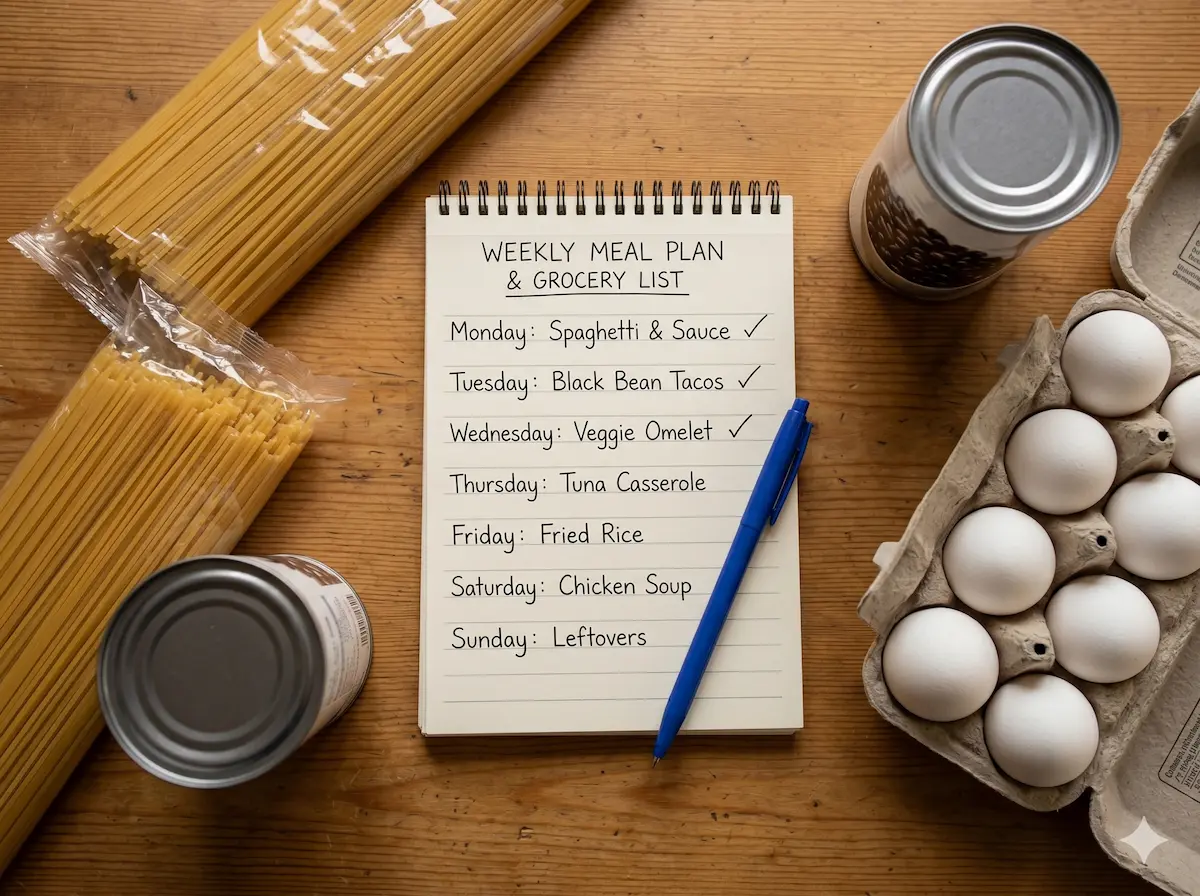
The weekly meal plan: ten minutes on Sunday that saves thirty dollars and four arguments the rest of the week.
📋 A Realistic Monthly Family Budget Example
This is an example, not a prescription. Your numbers will look different depending on where you live, how many kids you have, and your income. The point isn’t to match these figures — it’s to see the categories so you can find where your own leaks are.
Sample Monthly Budget — Family of 4
Example only
Category
Est. Monthly
Controllable?
Housing
Largest share
Low short-term
Groceries
$600–$900
High ✓
Eating out / takeout
$200–$500+
High ✓
Childcare
Varies widely
Low
Transportation
$300–$600
Medium
Healthcare
Varies widely
Low
Clothing and shoes
$50–$150
Medium-High ✓
School and activities
$100–$400
Medium-High ✓
Random kid costs
$50–$200
Medium ✓
Figures are estimates for illustration only and vary significantly by location, income, and family situation.
🚨 The Biggest Budget Leak for Busy Moms: Convenience Spending
This is the one nobody talks about directly. It’s not a character flaw — it’s what happens when you’re exhausted, there’s no plan, and the path of least resistance costs $45.
Where Convenience Spending Hides
Takeout after exhausting days — especially when there’s no backup meal ready
Last-minute grocery runs — you go for two things, spend $60
Individually packaged snacks — 3x the cost of portioning bulk items yourself
Buying duplicates — because the original is lost somewhere in the house
Emergency school purchases — the project due tomorrow that you didn’t know about until 9pm
Random Amazon orders — small amounts that are never as small as they feel in the moment
Christie’s note: The problem isn’t that you bought pizza after a long day. The problem is when every week has three nights where there was no plan, no backup meal, and no energy left. That pattern is what actually costs you — and it’s fixable with a system, not willpower.
The Full System
Food is the most movable line in most family budgets. If you want the full system — 30 meals, a weekly rotation, and a Sunday prep routine — it’s all here: easy budget meals for busy moms.
Free Download
Free Weekly Meal Planner & Grocery List
If groceries and takeout are eating your budget, this is the first fix — plan 5 dinners before you shop and watch the week get easier.
💡 10 Ways to Lower the Cost of Raising Kids Without Making Life Miserable
These are the ones that actually compound. None of them require you to clip coupons, comparison-shop for 45 minutes, or sacrifice anything that matters.
The 10 That Actually Work
1. Write a 5-dinner meal plan before you shop every week. Every item on your grocery list has a purpose. You stop buying things that don’t become meals.
2. Keep 3 emergency dinners in the house at all times. Pasta and jarred sauce. A rotisserie chicken. A bag of frozen dumplings. The point is to have a backup so you don’t default to $40 takeout on the nights the plan falls apart.
3. Build a pantry staples list and actually maintain it. When you have rice, canned beans, pasta, eggs, and canned tomatoes, you always have dinner. See the full list in the budget meals guide.
4. Start a gift closet. Whenever you find a good deal on a gift, book, or toy, buy it and store it. Birthday party invite comes home mid-week? Already handled.
5. Buy clothing one size ahead at end-of-season clearance. The per-item cost drops 50–70% and you’re never in emergency-purchase mode because they outgrew something.
6. Check the library before paying for any activity or entertainment. Most public libraries offer free programs, passes to local museums, summer reading prizes, and event tickets. Most families don’t use a fraction of what’s available to them.
7. Set a weekly “kid expenses” budget. A set amount per week for school, activities, and miscellaneous kid costs forces you to prioritize instead of just saying yes to everything as it comes up.
8. Keep a “needs soon” running list. When you notice a kid is about to need something — next shoe size, a new backpack, winter coat — add it to the list now so you can buy it on sale instead of in a rush.
9. Limit organized activities to one per kid per season. Multiple overlapping activities is one of the fastest ways to blow a family budget — and the research on kids doing fewer activities with more depth is actually pretty solid.
10. Make snacks easy to grab at home. A snack bin, pre-portioned fruit, or a simple after-school rotation cuts both convenience store spending and the constant negotiation about what kids can eat.
🚀 What I’d Focus on First If Money Feels Tight
If everything feels tight at once, don’t try to fix everything at once. Start with the area that gives you the fastest relief and builds momentum. For most families, the order looks like this:
Priority Order for Quick Relief
1. Food plan first. This is the fastest win. A weekly meal plan and three emergency backup dinners will save most families $100–$200/month in takeout and wasted groceries within the first few weeks.
2. Audit the convenience spending. Look at last month’s bank statement and circle every purchase that was unplanned. That number is usually surprising — and mostly fixable with a small amount of Sunday prep.
3. Do a clothing and shoe inventory. Know what sizes you need for the next 12 months. Then you can buy on purpose instead of in a panic.
4. Look at activity spending. Is everything currently enrolled in being actively enjoyed? It’s okay to pause things that aren’t working.
5. Childcare or schedule review if possible. If childcare is crushing the budget and there’s any flexibility in work arrangements, even one day of schedule adjustment can make a material difference.
Christie’s note: Start with food. It’s the most immediate, the most controllable, and fixing it gives you momentum for everything else. The other categories are real — but food is where most families find the first breathing room.
Go Deeper
The full dinner system — 30 meals, pantry foundation, and Sunday prep routine — is all in one place: easy budget meals for busy moms.
Common Questions
Cost of Raising a Child — Questions Answered
How much does it cost to raise a child?
National estimates for the cost of raising a child to age 18 are consistently in the hundreds of thousands of dollars, though the exact figure varies significantly by location, household income, childcare needs, and family choices. This estimate typically does not include college. The biggest categories are housing, childcare, food, transportation, healthcare, and clothing.
What is the biggest cost of raising a child?
Housing is typically the largest single category in most estimates, followed by childcare for working parents. Food is usually the third largest — and unlike housing and childcare, it’s also one of the most controllable categories for most families with meal planning and a budget grocery system.
How can I lower the cost of raising kids?
Start with food — a weekly meal plan and three emergency backup dinners will reduce most families’ takeout and grocery waste by $100–$200/month quickly. Then audit convenience spending, do a clothing inventory so you’re buying on purpose rather than in a panic, and evaluate activity costs. Buying clothes one size ahead at end-of-season clearance, using the library’s free programs, and maintaining a gift closet for birthday parties also make a consistent difference.
Does the cost of raising a child include college?
Most commonly cited estimates for the cost of raising a child cover birth to age 18 and do not include college tuition, room and board, or college savings contributions. College costs are typically calculated separately and can add significantly to the total depending on the school, location, and whether financial aid is available.
Why is raising kids so expensive?
Kids affect nearly every budget category simultaneously — housing, food, transportation, childcare, healthcare, clothing, school, activities, and household supplies all increase. The recurring “small” costs — snacks, supplies, birthday gifts, field trips, shoes — add up faster than most parents expect because they come constantly and feel individually minor. Add convenience spending (takeout and last-minute purchases on hard days) and the total is higher than any single line item suggests.
You’re Not Doing It Wrong — It’s Just Actually Expensive
Raising kids costs a lot. That’s not a personal finance failure — it’s just the reality of what it takes to feed, clothe, transport, educate, and care for children in the current economy. The goal isn’t to eliminate costs that are structural. The goal is to find the ones that are genuinely movable and build simple systems around them so you’re not hemorrhaging money on the same categories every month by default.
For most families, food is the fastest place to start. A weekly meal plan, a stocked pantry, and three emergency backup dinners will do more for your budget in the next 30 days than almost anything else on this list. The full system is laid out in the guide to easy budget meals for busy moms — it’s worth bookmarking.
Which cost hits your family budget hardest right now?
Drop it in the comments — groceries, childcare, activities, or something else entirely. 👇
Disclosure: This post may contain affiliate links. If you purchase through one of my links, I may earn a small commission at no extra cost to you. I only recommend things I genuinely use or believe in. Read my full disclaimer here.
About Christie
Christie is a busy mom based in New York writing about real life — quick meals, smart buys, and the honest truth about keeping it together when you’re pulled in twelve directions at once. No Pinterest perfection here, just practical strategies that actually work.