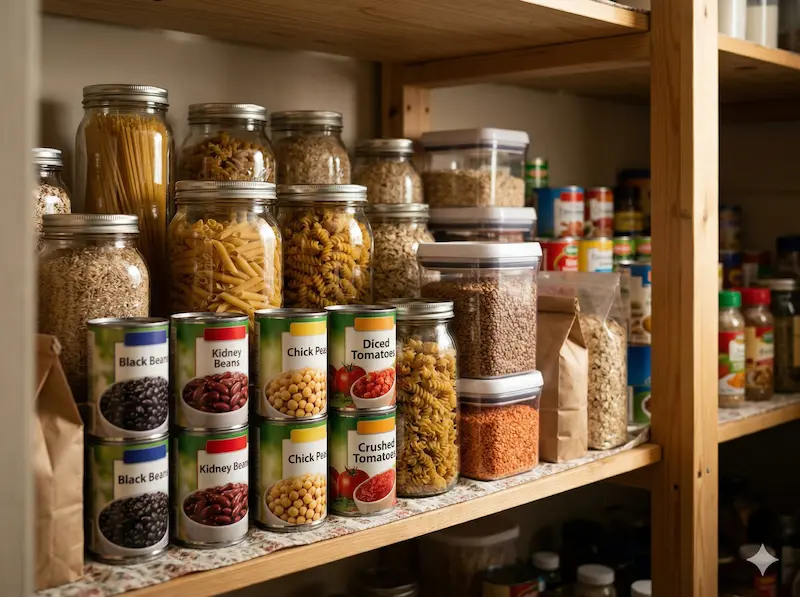
A good grocery list for a family on a budget isn’t just a list of things to buy — it’s a system that prevents impulse spending, cuts food waste, and means you always have what you need to get dinner on the table without a panic run at 5pm. I’ve been refining mine for years, and this is the version that finally stuck.
I’ve organized it by category, priced out each section, and included actual notes on what to make with each item — because a grocery list that doesn’t connect to real meals isn’t useful to anyone. Once these pantry staples are stocked, you can make dozens of different dinners without buying much else week to week. It’s the difference between opening the fridge and panicking versus opening the fridge and seeing dinner.
Quick Answer
A budget grocery list for a family must include versatile staples: dried pasta, white rice, canned beans, canned tomatoes, chicken broth, eggs, flour tortillas, frozen vegetables, and a core spice collection. These items alone produce two to three weeks of varied weeknight dinners for a family of four. The most important rule: buy store brand on every single item in this list — same product, half the price.
🌾 Grains & Pasta — The Foundation of Every Budget Meal
Grains and pasta are the backbone of budget cooking. Filling, versatile, cheap per serving, and shelf-stable for months. These should always be in your pantry — when everything else runs out, these keep dinner possible.
White rice — 5 lb bag
~$3–5 · Lasts indefinitely
The most versatile pantry item you own. Base for chicken bowls, fried rice, bean bowls, stir-fry, and soup. Cook extra every single time — cold rice makes the best fried rice, and leftover cooked rice in the fridge means dinner is 10 minutes away on any given night.
Christie’s tip: Cook rice in chicken broth instead of water — same effort, dramatically better flavor, and it makes even plain rice taste intentional.
Dried pasta — multiple shapes
~$1–2 per lb · Lasts 2 years
Spaghetti for meat sauce, penne for baked dishes, elbows for mac and cheese and soups. Buy at least two shapes at all times. Store-brand pasta is identical to name-brand — save the dollar on every box and you’re saving $5–10 per month on pasta alone.
Christie’s tip: Stock spaghetti, penne, and elbow. Those three shapes cover basically every pasta recipe worth making on a budget.
Old-fashioned oats — large canister
~$4–6 · Under $0.50/serving
Breakfast handled for weeks. Overnight oats, baked oats, oatmeal with fruit — all fast, filling, and ridiculously cheap per serving. Buy the large store-brand canister. One purchase covers breakfast for an entire family for 2–3 weeks.
Christie’s tip: Overnight oats take 3 minutes to prep the night before. Five jars on Sunday = breakfast sorted for the week. No thinking required at 7am.
Dried red lentils
~$2 per bag · High protein
No soaking required, cooks in 20 minutes. Make lentil soup, add to pasta sauce to stretch it further, or serve over rice as a complete protein meal. One $2 bag makes multiple dinners. This is one of the most underused budget ingredients in most family kitchens.
Christie’s tip: Add a cup of red lentils to any tomato-based pasta sauce while it simmers — they dissolve in and thicken the sauce while doubling the protein. Kids never notice.
Flour tortillas — large pack
~$3–4 · Freezes well
Quesadillas, tacos, wraps, burritos, pizza bases. One of the most versatile items in the budget pantry — a pack of tortillas and whatever protein you have means dinner is always an option. Freeze half if you won’t use them all within a week. They thaw in 30 seconds on a warm skillet.
Christie’s tip: Bean and cheese quesadillas with frozen tortillas cost about $0.40 each and take 5 minutes. Keep these as the emergency “nothing in the house” dinner and you’ll never order pizza in a panic again.
A stocked pantry means dinner is always possible — even when the fridge is nearly empty.
🥩 Budget Protein Grocery List for Families
Protein is where most family grocery budgets bleed money — and where the biggest savings are available if you know which cuts and formats to buy. The goal is maximum protein per dollar, not maximum variety.
Chicken thighs — family pack
~$1.20–1.80/lb · Best value meat
The best-value meat in the store, full stop. More flavorful than breasts, stay moist in any cooking method, and work for tacos, rice bowls, slow cooker meals, BBQ, soup, and stir-fry. Buy the family pack — it’s always significantly cheaper per pound than smaller packages — and freeze in groups of four.
Christie’s tip: When chicken thighs go on sale below $1.50/lb, buy as many as will fit in your freezer. That’s the floor price — anything above it, wait for the next sale.
Ground beef 80/20 — family pack
~$3.50–5/lb · Freeze in 1 lb portions
Tacos, pasta sauce, chili, burgers, meatballs, hamburger helper. Buy in bulk and portion into 1 lb freezer bags before freezing — pulling out exactly what you need is much easier than defrosting a 3 lb brick. 80/20 has enough fat for flavor; leaner ground beef dries out in most applications.
Christie’s tip: Portion and freeze ground beef the same day you buy it. If it goes in the fridge whole, it gets forgotten and wasted. Freezer portions = money that actually gets used.
Smoked sausage or kielbasa
~$3–5 per pack · Already cooked
Already fully cooked — just slice and heat. Sheet pan meals, pasta, rice dishes, soups, and bean dishes. One of the most convenient and affordable proteins available. Slice into rounds and caramelize in a skillet until the edges crisp up — that 5-minute step makes the whole dish taste like you actually tried.
Christie’s tip: Kielbasa + frozen peppers + rice = dinner in 15 minutes with zero planning. Keep one in the freezer specifically for those nights when nothing else is thawed.
Eggs — 18-pack
Most flexible budget protein
Breakfast, fried rice, shakshuka, frittata, scrambled egg tacos, egg salad, pasta carbonara. Eggs are the single most flexible budget protein — they go with almost anything, cook in minutes, and cost under $0.30 each at most stores. Always buy the 18-pack, not the dozen. The per-egg savings add up fast over a month.
Christie’s tip: “Eggs for dinner” is a legitimate budget meal strategy, not a failure. Scrambled eggs with cheese and toast, or fried eggs over rice with soy sauce, costs under $1.50 for the whole family.
Dried beans — black, kidney, pinto
~$1.50–2 per bag · 40% cheaper than canned
Dried beans are 40–50% cheaper per serving than canned and produce a much better texture when cooked from scratch. With a pressure cooker you can skip soaking entirely — dried beans cook in 25–35 minutes on high pressure. One $2 bag of dried black beans makes roughly 6 cans’ worth of cooked beans. This is the Instant Pot I use for dried beans →
Christie’s tip: Cook a full bag on Sunday and refrigerate in portions. Use throughout the week in tacos, rice bowls, soups, and quesadillas — it changes the economics of beans entirely.
🥫 Canned & Jarred Goods — The Budget Pantry Core
These are the items that make the pantry feel like a pantry — the building blocks every budget recipe reaches for. Buy four to six of each when they’re on sale and you’ll rarely run out.
Canned beans — mixed varieties, 4–6 cans
~$0.80–1.20 per can
Black beans for tacos and rice bowls, kidney beans for chili, cannellini for soups and pasta. Buy four to six cans at a time. These are the fastest budget protein in existence — open, drain, rinse, season, done in three minutes. Keep multiple varieties so you have options depending on what else you’re making that night.
Christie’s tip: Store brand canned beans are identical to name brand. The only difference is the label. Switch and save $0.30–0.50 per can — across 6 cans that’s $3 back in your pocket every shop.
Canned diced tomatoes — 4 cans
~$0.80–1.50 per can
The base of chili, soup, pasta sauce, shakshuka, and stews. Buy four cans as your baseline and restock when you get to two. Fire-roasted diced tomatoes add noticeably more flavor for the same price — worth choosing over standard diced when you find them. Store brand is fine for everything else.
Christie’s tip: A can of diced tomatoes + a can of beans + broth + any protein = soup. That formula has gotten me through more empty-fridge weeks than I can count.
Jarred marinara sauce — 2 jars
~$2–4 per jar
Pasta nights, pizza, baked dishes, dipping sauce. When a jar of marinara is in the pantry, dinner is always 20 minutes away. Keep two jars. Rao’s is the best quality jarred sauce and goes on sale regularly — worth stocking when it drops below $6. Store brand works fine for everyday weeknight pasta.
Christie’s tip: Add a splash of heavy cream and a handful of parmesan to store-brand marinara while it heats — it tastes like a restaurant sauce for $0.40 extra.
Chicken & beef broth — 32 oz cartons
~$2–3 per carton · Keep 2 of each
Soups, rice cooked in broth instead of water, slow cooker meals, pasta cooking liquid, gravy. Keep two of each in the pantry at all times. Buy low-sodium so you control the salt level yourself — regular broth often makes recipes taste over-salted before you add anything else. Store brand is identical to name brand here.
Christie’s tip: Save Parmesan rinds in a freezer bag and toss one into any broth-based soup as it simmers. Free flavor upgrade that tastes like you spent an extra hour cooking.
Canned corn + canned green chiles
~$0.80–1.20 per can
Cheap flavor-builders that make budget meals taste less like budget meals. Corn goes into soups, rice dishes, quesadillas, and burrito bowls. Green chiles add instant depth to chicken soup, white chili, tacos, and scrambled eggs. Keep two cans of each — they cost almost nothing and earn their pantry space every single week.
Christie’s tip: A can of green chiles in a pot of chicken soup transforms it from plain to “what did you put in this?” — costs $0.80 and takes five seconds to add.
🥦 Produce & Frozen Vegetables for Budget Families
The rule: buy fresh for what you’ll use within 3 days. Buy frozen for everything else. Frozen vegetables are picked and frozen at peak ripeness — nutritionally identical to fresh, they never go bad, and they cost a fraction of the price. A bag of frozen broccoli is $1.50 and lasts months. Fresh broccoli forgotten in the crisper drawer costs $2.50 and ends up in the trash.
Fresh produce — buy weekly
Use within 3 days
Onions (yellow, 3 lb bag), garlic (whole heads — not pre-minced), russet potatoes (5 lb bag), bananas, whatever fruit is on sale that week, carrots (1 lb bag), cabbage. Cabbage is massively underrated — incredibly cheap, lasts 2–3 weeks in the fridge, and works in stir-fry, soups, slaws, and tacos.
Christie’s tip: Buy the fruit that’s cheapest that week, not the fruit you’re used to buying. Seasonality drives price — flexibility here saves $5–8 per week on produce alone.
Frozen vegetables — keep stocked
Lasts months · Buy the large bags
Mixed vegetables (large bag), broccoli florets, peas, corn, sliced bell peppers (no chopping required), edamame, spinach for soups and smoothies. These go directly into almost every recipe — no thawing, no prep, no waste. The large bags cost less per ounce than the smaller bags. Always buy the big one.
Christie’s tip: Frozen sliced bell peppers are the single most useful convenience item in budget cooking. No chopping, no waste, go straight from freezer to pan. Worth every cent of the small premium over fresh.
Shopping with a list is the single most effective budget tool. If it’s not on the list, it doesn’t go in the cart.
🥚 Dairy & Eggs — Budget Essentials
Every item in this section has a cheaper version that performs identically. The savings here are straightforward — you just have to stop buying the name brand out of habit.
Weekly dairy list
Store brand everything
Eggs (18-pack), milk (store brand), butter (1 lb block), block cheese instead of pre-shredded, plain yogurt in a large tub not individual cups, sour cream. These are the core dairy items that appear in budget recipes constantly. Buy every single one in store brand — the savings across this section run $8–12 per week compared to name brand equivalents.
Christie’s tip: Buy block cheese and shred it yourself. Pre-shredded costs 30–40% more and has anti-caking agents that make it melt differently. A box grater takes 60 seconds and the cheese melts properly. Freeze butter when it goes on sale — it freezes perfectly for months.
🧂 The Spice & Condiment List That Makes Budget Meals Taste Good
This is where most people underinvest — and it’s why budget meals get a bad reputation. A good spice collection turns a $4 bean dinner into something genuinely craveable. Buy these once and they last months.
Essential spices
Buy once, lasts months
Cumin, chili powder, garlic powder, onion powder, paprika (regular and smoked), Italian seasoning, oregano, black pepper, kosher salt, red pepper flakes. This is the complete set — with these eleven spices you can season any cuisine and any protein. Nothing on this list is exotic or hard to find.
Christie’s tip: Buy spices from the bulk bin or ethnic food aisle — same spice, 2–3x the quantity for the same price as the grocery store jar. The McCormick rack is the most expensive way to buy spices in the store.
Essential condiments
Buy the large sizes
Olive oil (large bottle), soy sauce, hot sauce, BBQ sauce, mustard, jarred salsa, Worcestershire sauce, apple cider vinegar, honey. These are the flavor backbone of dozens of recipes and they last a long time. Buy the largest size available — the cost per ounce drops significantly and you won’t run out mid-recipe.
Christie’s tip: Soy sauce + garlic + a little honey = instant Asian-style sauce for anything. Worcestershire + mustard + ketchup = burger sauce or meatloaf glaze. Learning how condiments combine is worth more than any recipe book.
💡 Budget Grocery Shopping Rules That Actually Work
The list matters, but so does how you shop. These five rules are what separate families who consistently stay under budget from those who overspend every week despite good intentions.
Rule 1: Shop your pantry before you shop the store
Prevents duplicates
Before writing your grocery list, spend five minutes looking at what you already have. Most families have enough pantry ingredients for two or three dinners they’re not using. This prevents buying duplicates of things you already own and forces you to actually use what’s there before it expires. Half of food waste starts with not knowing what you already have.
Christie’s tip: Keep a running note on your phone called “pantry” — add items when you open the last one, not when you run out. Never buy a duplicate again.
Rule 2: Never shop without a meal plan
Saves $20–30/week
Every item on your list should tie to a specific meal you’re actually planning to cook. “I might make tacos” results in buying taco ingredients that sit unused. “I’m making tacos on Tuesday” means buying exactly what you need and using it. The difference in food waste between these two approaches is $20–30 per week for most families. This is the meal planning notepad I use every Sunday →
Christie’s tip: Five dinner slots. That’s it. You don’t need a color-coded system — you need five dinners written down before Sunday ends. Everything else follows from that.
Rule 3: Buy store brand on everything in this list
Saves $15–25 per trip
Canned beans, pasta, rice, broth, frozen vegetables, butter, milk, yogurt, sour cream — the store brand is manufactured in the same facilities as the name brand in the majority of cases. You’re paying for packaging and marketing, not a better product. On a full cart of these items, switching to store brand saves $15–25 per shopping trip. That’s over $100 per month.
Christie’s tip: The only categories where brand sometimes matters: pasta sauce (Rao’s vs. store brand is a noticeable quality difference), and yogurt (texture varies). Everything else — store brand, every time.
Rule 4: Use a cashback app
Free $5–15/month
Ibotta and Fetch Rewards both give cash back on grocery purchases — including store-brand items and staples on this list. Takes two minutes to set up. Earns $5–15 per month on groceries you’re buying anyway. Not life-changing, but it’s genuinely free money and the bar to entry is installing an app.
Christie’s tip: Check the app before you write your grocery list, not after you shop. Some weeks there are offers on exactly what you were already planning to buy — you just have to look first.
Rule 5: Don’t shop hungry — and try to shop alone
Prevents $20–30 in extras
Shopping hungry adds $15–20 in impulse purchases to the average cart. Kids add another $10–15. Neither is about willpower — it’s just math. Eat before you go. If the kids absolutely have to come, give each one a specific job (finding the pasta, picking a fruit from the list) so they’re contributing rather than grabbing. It helps. Slightly.
Christie’s tip: I do a click-and-collect order for the big weekly shop and only go in-store for quick mid-week pickups. It’s genuinely the single most effective way to cut impulse purchases — you can’t grab something off the shelf if you’re not in the store.
📦 How to Build a Family Grocery Stockpile on a Budget
A stockpile doesn’t mean buying a year’s supply at once. It means buying two or three extra non-perishable items each week so your pantry gradually fills to the point where you could cook for two weeks without needing to shop. This takes a few months to build, costs a few extra dollars per week to get there, and then pays for itself repeatedly.
The simple stockpile system
$5–8 extra per week
Each week: buy two extra cans of beans, one extra can of tomatoes, and one extra box of pasta. When meat goes on sale, buy double and freeze immediately in meal portions. When pasta goes on sale, buy four boxes instead of two. When canned goods go on sale, buy six instead of two. The goal is two weeks of non-perishable dinner ingredients sitting in your pantry at all times — a buffer that eliminates emergency runs and keeps your options open on tight weeks. These are the pantry bins I use to keep everything sorted →
Christie’s tip: Stockpile in this order: pasta and rice first, then canned beans and tomatoes, then broth, then frozen vegetables. Get two weeks of those five categories before focusing on anything else — they’re the foundation of every cheap dinner on this site.
Put It All Together
Now that the pantry list is sorted, the next step is turning it into a real weekly meal rotation. Read the complete guide to easy budget meals for busy moms to see exactly how these ingredients map to a full week of cheap, fast family dinners.
Free Download
Free Weekly Meal Planner & Grocery List
The printable that pairs with this grocery list — plan five dinners, write the shopping list, and stop spending money on things you don’t use.
What should be on a budget grocery list for a family?
A budget grocery list for a family must include versatile staples that form the base of multiple cheap meals: dried pasta, white rice, canned beans (black, kidney, cannellini), canned diced tomatoes, chicken and beef broth, eggs (18-pack), flour tortillas, frozen vegetables, and a core spice collection. For proteins, prioritize chicken thighs, ground beef in bulk, and eggs — in that order of cost-to-versatility ratio. These items alone produce two to three weeks of varied weeknight dinners for a family of four on a minimal weekly spend.
How do you build a family grocery stockpile on a budget?
Build a stockpile by adding two or three extra non-perishable staple items to your cart each week — an extra can of beans, an extra box of pasta, an extra can of tomatoes. When meat goes on sale, buy double and freeze in meal-sized portions. When canned goods are on sale, buy six instead of two. Over two to three months this builds a two-week pantry buffer that gives you financial flexibility during tight weeks and eliminates emergency store runs. Start with pasta, rice, canned beans, canned tomatoes, and broth — those five categories are the foundation of the cheapest meals you can make.
Is it cheaper to buy dried beans or canned beans?
Dried beans are 40–50% cheaper per serving than canned, but require soaking and longer cooking time. A pressure cooker eliminates the soaking requirement entirely — dried beans cook in 25–35 minutes on high pressure with no planning ahead. A $2 bag of dried black beans produces the equivalent of roughly 6 cans of cooked beans. If you have a pressure cooker, dried beans are significantly better value. If you don’t, canned beans are still one of the cheapest proteins available and worth buying in bulk when they’re on sale.
Should I buy fresh or frozen vegetables on a budget?
Buy fresh produce only for what you’ll use within 2–3 days, and frozen for everything else. Frozen vegetables are picked and flash-frozen at peak ripeness — nutritionally equal to fresh, significantly cheaper per serving, and they never go bad. For budget cooking, a well-stocked freezer with broccoli, mixed vegetables, corn, peas, and bell peppers is more valuable than a fridge drawer full of fresh produce that might get forgotten. The only fresh produce worth buying every week regardless of season: onions, garlic, potatoes, carrots, and bananas.
How do I cut my grocery bill in half?
The five changes that make the biggest difference: always shop with a written meal plan so nothing goes unused; switch to store brand on every pantry staple; replace meat with eggs or beans at least two nights per week; buy fresh produce only for what you’ll use in 3 days and rely on frozen for the rest; and audit your pantry before writing your grocery list to avoid buying duplicates. Together these changes typically reduce a family grocery bill by 25–40% within the first month — without changing what you eat in any meaningful way.
Stock the Pantry, Skip the Panic
The best grocery list for a family on a budget isn’t about eating less or eating worse. It’s about having the right things on hand so dinner is always possible, food waste is minimal, and you’re not making emergency runs to the store three times a week because nothing was planned. Once these staples are consistently stocked, the decision fatigue of “what’s for dinner” drops dramatically — because the answer is almost always already in the house.
Start with the grains, proteins, and canned goods sections. Add two or three extra items per category each week until your pantry is consistently stocked. For where to take it from here — how to turn this grocery list into a real weekly dinner plan — read the complete guide to easy budget meals for busy moms. And for fifteen specific dinners that use exactly these ingredients, cheap dinners for a family of 4 has you covered.
What’s the one pantry item you absolutely cannot cook without?
Drop it in the comments — I’m always curious what other budget cooks consider non-negotiable. 👇
You Might Also Like
Easy Meals
30 Easy Budget Meals for Busy Moms (A Realistic System)
Read more →
Easy Meals
15 Cheap Dinners for a Family of 4 (Under $10 Total)
Read more →
Disclosure: This post may contain affiliate links. If you purchase through one of my links, I may earn a small commission at no extra cost to you. I only recommend things I genuinely use or believe in. Read my full disclaimer here.
About Christie
Christie is a busy mom based in New York writing about real life — quick meals, smart buys, and the honest truth about keeping it together when you’re pulled in twelve directions at once. No Pinterest perfection here, just practical strategies that actually work.