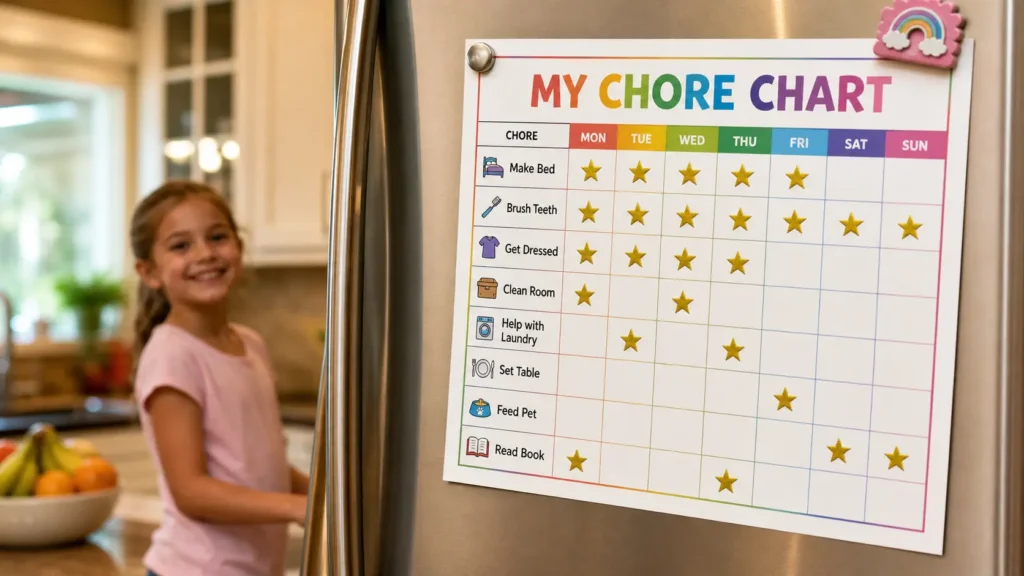
Every chore chart I tried failed within two weeks — not because my kids were bad, but because the system wasn’t built right. Too many chores, no real reward, and nothing that made them feel like they’d actually accomplished something. The kids chore chart printable that actually works in our house has one key difference: the reward is concrete, it’s theirs, and they can see it accumulating all week.
This is a free Kids Chore Chart Printable download, designed for ages 3–12, with age-appropriate chore suggestions built in. Laminate it once, and it runs itself — no nagging required (or at least, significantly less).
Quick Answer
A kids chore chart with a star reward system works best when: chores are age-appropriate (3–5 year olds do simple tasks like putting toys away; 9–12 year olds handle more complex tasks like vacuuming), the reward is chosen by the child at the start of the week, and the chart is laminated on the fridge so progress is visible daily. Kids stay motivated when they can see the stars accumulating.
Giving a 4-year-old a chore they can’t do sets everyone up to fail. Here’s the breakdown by age group that the chart is built around — these are chores kids can actually complete independently at that age, with minimal supervision.
Ages 3–5: Simple, Visible Tasks
Toddler + PreK
Put toys away in bins, bring dishes to the sink, wipe table with a cloth after meals, make bed (loosely — doesn’t need to be perfect), feed the pet with supervision, put dirty clothes in hamper.
Christie’s tip: At this age, the goal is building the habit, not the result. The toys don’t need to be sorted perfectly. The bed doesn’t need to be smooth. Getting them in the routine now pays off enormously by age 7.
Ages 6–8: Real Responsibilities
Elementary
Load/unload the dishwasher, sweep the kitchen floor, set and clear the table, take out recycling, pack their own school bag, fold and put away their laundry, water plants.
Christie’s tip: This is the age group where the chore chart has the highest compliance — old enough to do real chores, young enough to still be motivated by stars and rewards. Take advantage of it.
Ages 9–12: More Independent Tasks
Tween
Vacuum common areas, clean the bathroom sink and toilet, cook a simple meal with supervision, take out trash on collection day, handle their own laundry (wash + dry + fold), clean their room independently.
Christie’s tip: At this age, shift the reward from stars to something more “mature” — extra screen time, a later bedtime one night, or a small amount of allowance. The star chart still works, but the reward needs to feel bigger.
Kids who have chores from an early age are more self-sufficient — and considerably less likely to stand in the kitchen and ask you to find their shoes.
⭐ The Star Reward System That Actually Works
Most chore chart reward systems fail for one reason: the reward is vague. “You did a good job this week” is not a reward — it’s a compliment. Kids need something concrete to work toward. Here’s the system I use:
The Monday Reward Setup
Do this first
Every Monday, ask your kid to choose this week’s reward — something they actually want. Give 2–3 options you’re comfortable with: “This week you can earn extra screen time, a movie night, or we can bake something together.” They pick one. That’s the target.
Don’t require a perfect week. Set a threshold — for example, 4 out of 5 chores completed each day earns a star. Collect enough stars by Saturday and they get the reward. This builds in room for hard days without blowing the whole week.
Christie’s tip: We use 80% completion as the threshold. That means missing one or two chores across the week doesn’t torpedo the reward — but doing nothing doesn’t earn it either.
The stars accumulating across the week do the motivating for you. You don’t have to say anything — the chart says it.
🗂️ How to Set Up the Chore Chart (Once, Forever)
The setup takes about 20 minutes. After that, the chart runs itself until the school year ends and you want to update the chores.
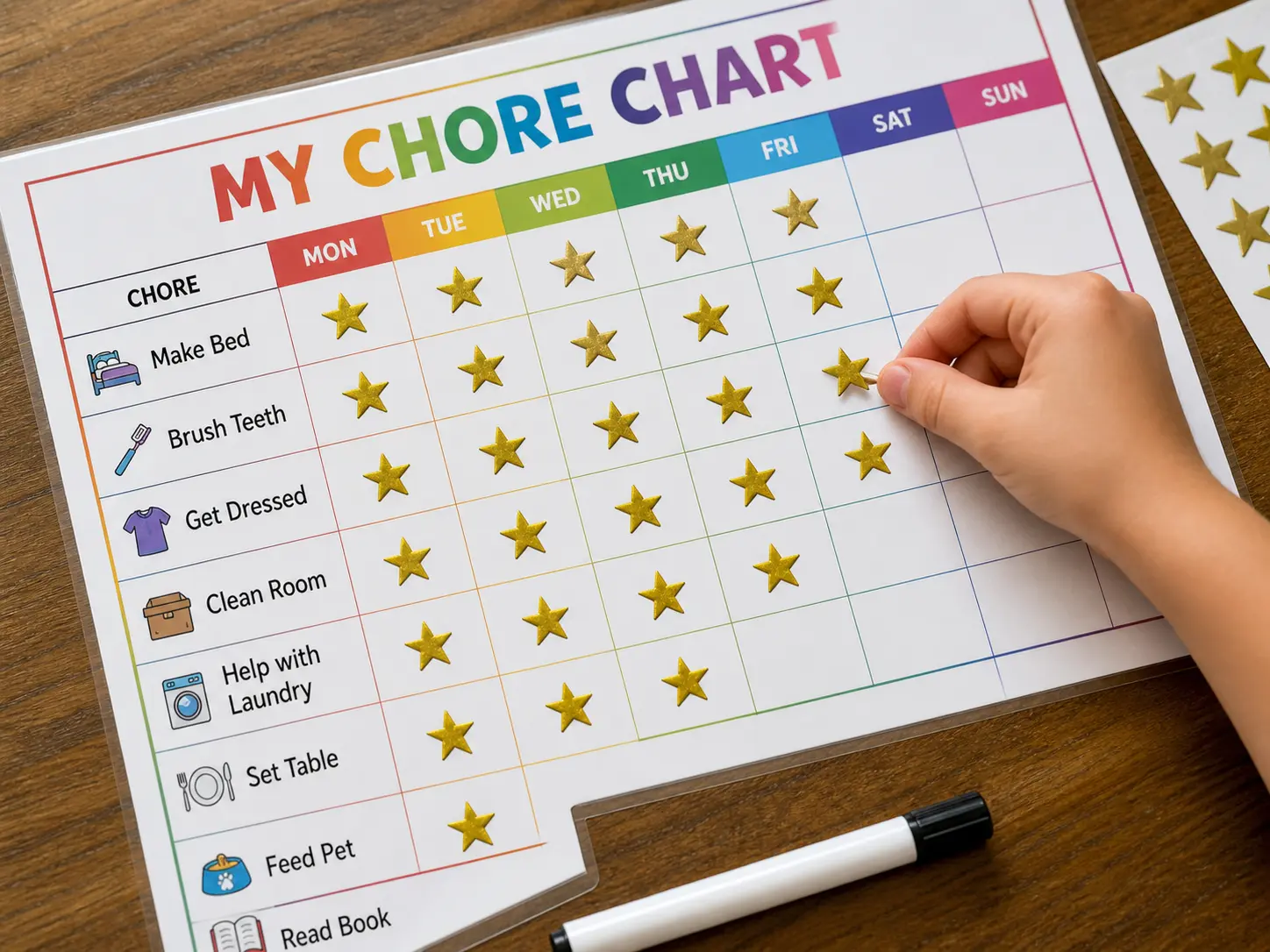
Use a dry-erase marker to write in the weekly chores. Do this WITH the kid — let them have input. “You can pick 2 of the 5 chores” gives them some control without losing the list. Agreed-to chores are more likely to be done than assigned ones.
Step 3: Hang it at kid eye level
Put it on the fridge or on their bedroom door — somewhere they walk past multiple times a day. Kid eye level, not parent eye level. The chart only works if they can see it and interact with it themselves.
The Full System
The chore chart pairs well with the morning routine chart — one handles the house, one handles the morning rush. Both are free in the full printables library. And for the meal side of running the house, the guide to easy budget meals for busy moms is the next read.
Free Download
Get the Free Kids Chore Chart
Join the list and get the chore chart + morning routine chart sent to your inbox — plus every new printable as it drops.
⚠️ Form not yet wired — build
Common Questions
Kids Chore Chart — Questions Answered
What age should kids start doing chores?
Kids can start simple chores as early as age 2–3, with tasks like putting toys in bins or bringing their plate to the sink. The goal at this age is building the habit, not the quality of execution. By age 5–6, kids can handle real responsibilities independently — putting away laundry, setting the table, and wiping down surfaces.
Should kids get paid for chores?
There are two schools of thought: some parents separate “household chores” (unpaid, everyone contributes) from “extra tasks” (paid, for above-and-beyond help). Others tie a small allowance to chore completion. Both work — what matters most is consistency. The star reward system on this chart uses non-monetary rewards that are often more motivating for younger kids than money anyway.
What do I do when my kid refuses to do chores?
First, check whether the chore is actually age-appropriate — resistance often signals the task feels overwhelming or unclear. Second, check whether the reward is motivating enough. If neither of those is the issue, hold the boundary calmly: the reward requires completing the chores, and a skipped chore means a missed star. Don’t negotiate the threshold mid-week.
How many chores per day is realistic for kids?
Ages 3–5: 1–2 chores per day. Ages 6–8: 2–3 chores per day. Ages 9–12: 3–5 chores per day. The chart is designed for realistic daily loads — not so few it feels pointless, not so many it triggers daily battles. School days should have lighter chore loads than weekends.
Can I laminate the chore chart so it’s reusable?
Yes — laminating is the recommended setup for this chart. Kids use a dry-erase marker to check off chores daily, and you wipe it clean each Monday. Star stickers go on for completed days and can be peeled off at the end of the week. A basic laminator is under $30 and lasts for years of printables.
A Chore Chart That Runs Without You
The star reward system works because it puts the motivation in the kid’s hands, not yours. You’re not chasing them down. You’re not repeating yourself twelve times. The chart is there, the reward is visible, and the daily checkboxes either get done or they don’t. Simple consequence, no drama.
Set it up once this weekend, let the kids help fill in the chores, and see what the following week looks like. And while you’re printing, grab the rest of the free printables for busy moms — the morning routine chart pairs especially well with this one.
What’s your most effective reward for getting kids to do chores?
Drop it in the comments — I’m always collecting new ideas for the reward list. 👇
Disclosure: This post may contain affiliate links. If you purchase through one of my links, I may earn a small commission at no extra cost to you. I only recommend things I genuinely use or believe in. Read my full disclaimer here.
About Christie
Christie is a busy mom based in New York writing about real life — quick meals, smart buys, and the honest truth about keeping it together when you’re pulled in twelve directions at once. No Pinterest perfection here, just practical strategies that actually work.